15 Things to Do in Genoa: From the Old Port to the Palazzi dei Rolli
Genoa, the hometown of Christopher Columbus, has what Visit Genoa calls the widest historic center in Europe. For visitors with only a few hours, the city's tourism office suggests a short walking itinerary through the heart of the city. See the walking itinerary on Visit Genoa

Genoa, the hometown of Christopher Columbus, has what Visit Genoa calls the widest historic center in Europe. For visitors with only a few hours, the city's tourism office suggests a short walking itinerary through the heart of the city. See the walking itinerary on Visit Genoa
Porto Antico
The Porto Antico, the old port area restored by Renzo Piano in 1992, is today the tourist center of the city. Besides the Aquarium, it holds attractions such as the Bigo panoramic lift and the Biosfera. See the walking itinerary on Visit Genoa More on getting around Genoa
The Aquarium of Genoa
The Aquarium of Genoa is the largest exhibition of aquatic biodiversity in Europe, with 70 tanks housing over 12,000 animals of 600 species, from dolphins, sharks and penguins to manatees, jellyfish and seals. It opened in 1992, for the 500th anniversary of Columbus's voyage to America, and has more than one million visitors a year. See the Aquarium on Visit Genoa
Galata Museo del Mare
On the way from the Maritime Station to the Porto Antico you pass the Galata Museo del Mare, which Visit Genoa calls the first maritime museum of the Mediterranean. See the walking itinerary on Visit Genoa
Palazzo San Giorgio and Piazza Caricamento
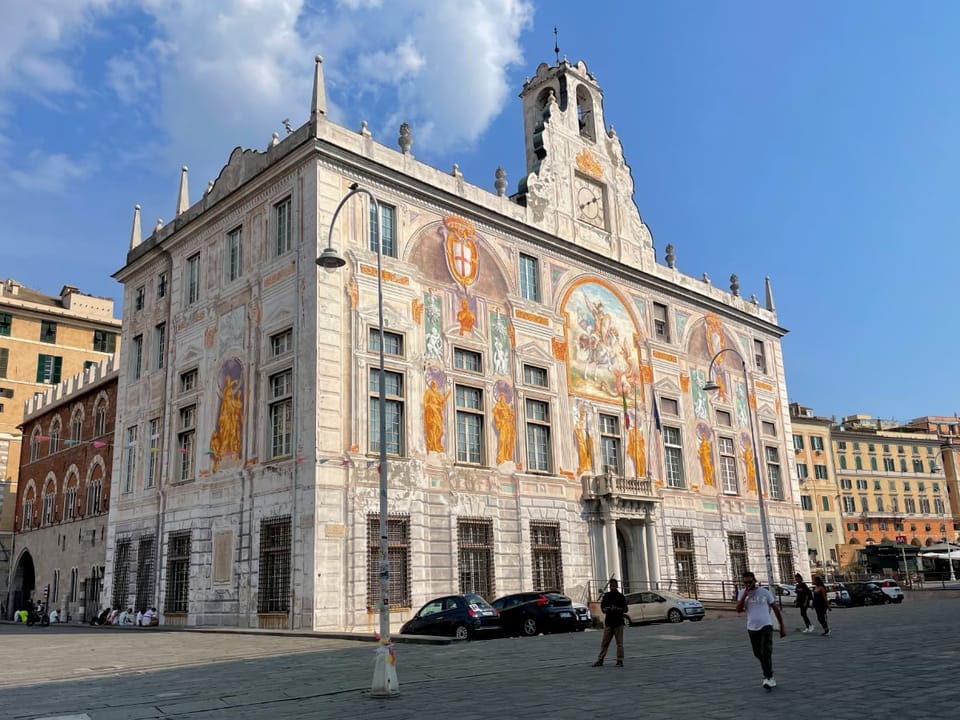
Piazza Caricamento takes its name from the goods once loaded and unloaded there. In the middle stands Palazzo San Giorgio, whose frescoed facade shows Saint George and the dragon. See the walking itinerary on Visit Genoa More on the Banco di San Giorgio
Piazza Banchi
Behind the palace, Piazza Banchi is home to the Loggia di Banchi, the site of Italy's first commodity exchange, and to the church of San Pietro in Banchi, which was built on top of a row of shops. See the walking itinerary on Visit Genoa
San Lorenzo Cathedral
The Cathedral of San Lorenzo was built between the twelfth and fourteenth centuries, with Romanesque sides and portals and a Gothic facade. Inside is the chapel of Saint John the Baptist, the patron saint of the city. See the walking itinerary on Visit Genoa
Porta Soprana and the Columbus House
Porta Soprana, built in the twelfth century, was once the main eastern entrance to the city. Next to it stands the home of Christopher Columbus, a seventeenth-century building on the foundations of the house believed to be his birthplace. See the walking itinerary on Visit Genoa
Piazza De Ferrari
Genoa's main square is named after Raffaele De Ferrari, Duke of Galliera, who in 1875 gave a large sum toward expanding the port. Its bronze fountain dates from 1936. Around it stand the Teatro Carlo Felice, the Accademia Ligustica di Belle Arti, the side of Palazzo Ducale, the Liguria region's palace of 1920 and the Palazzo della Nuova Borsa of 1912, a fine example of Genoese Art Nouveau. See Piazza De Ferrari on Visit Genoa
Palazzo Ducale
Palazzo Ducale, on Piazza De Ferrari, was the seat of the government of the Republic of Genoa from the sixteenth century. Its medieval core is the Torre Grimaldina, once a prison, which offers a fine view over the town. See the walking itinerary on Visit Genoa
Teatro Carlo Felice
The Teatro Carlo Felice is the city's opera house and the largest in the region. Badly damaged by bombing in the Second World War, it was rebuilt and reopened in 1991. It has its own orchestra and choir, and it is the home of opera, ballet and the symphonic season. See the Teatro Carlo Felice on Visit Genoa
Via Garibaldi and the Strada Nuova museums
Via Garibaldi, the historic Strada Nuova, is lined with palaces of the Palazzi dei Rolli. Palazzo Rosso, Palazzo Bianco and Palazzo Tursi form the Strada Nuova museums, with frescoed rooms and paintings by Guercino, Rubens, Van Dyck, Caravaggio and Strozzi. See the walking itinerary on Visit Genoa
The Palazzi dei Rolli
In 2006 UNESCO listed "Le Strade Nuove e il sistema dei Palazzi dei Rolli" as a World Heritage Site: 42 Renaissance and Baroque palaces of Genoa's aristocracy, out of more than 100 still standing in the historic center. Many can be visited all year, among them the Strada Nuova museums, the National Gallery of Palazzo Spinola di Pellicceria and the Museum of Palazzo Reale. See the Palazzi dei Rolli on Visit Genoa
Via Balbi and Palazzo Reale
Via Balbi, a seventeenth-century street, is today the seat of the University of Genoa. Palazzo Reale, the official residence of the House of Savoy from 1824, is known for its Hall of Mirrors on the model of Versailles. See the walking itinerary on Visit Genoa
La Lanterna
At 77 meters, the Lanterna is the tallest lighthouse in the Mediterranean and the second tallest in Europe. Built in 1128 and rebuilt in 1543, it stands on a 40-meter rock, and 172 steps lead to its first terrace, with views over the harbor and the historic center. A multimedia museum stands at its foot. See the Lanterna on Visit Genoa
Staglieno Monumental Cemetery
The Cimitero Monumentale di Staglieno opened to the public on January 1, 1851. Friedrich Nietzsche, Guy de Maupassant, Mark Twain and Evelyn Waugh were among the many writers and travelers who left accounts of their visits to its great monumental galleries. See Staglieno on the Comune di Genova website